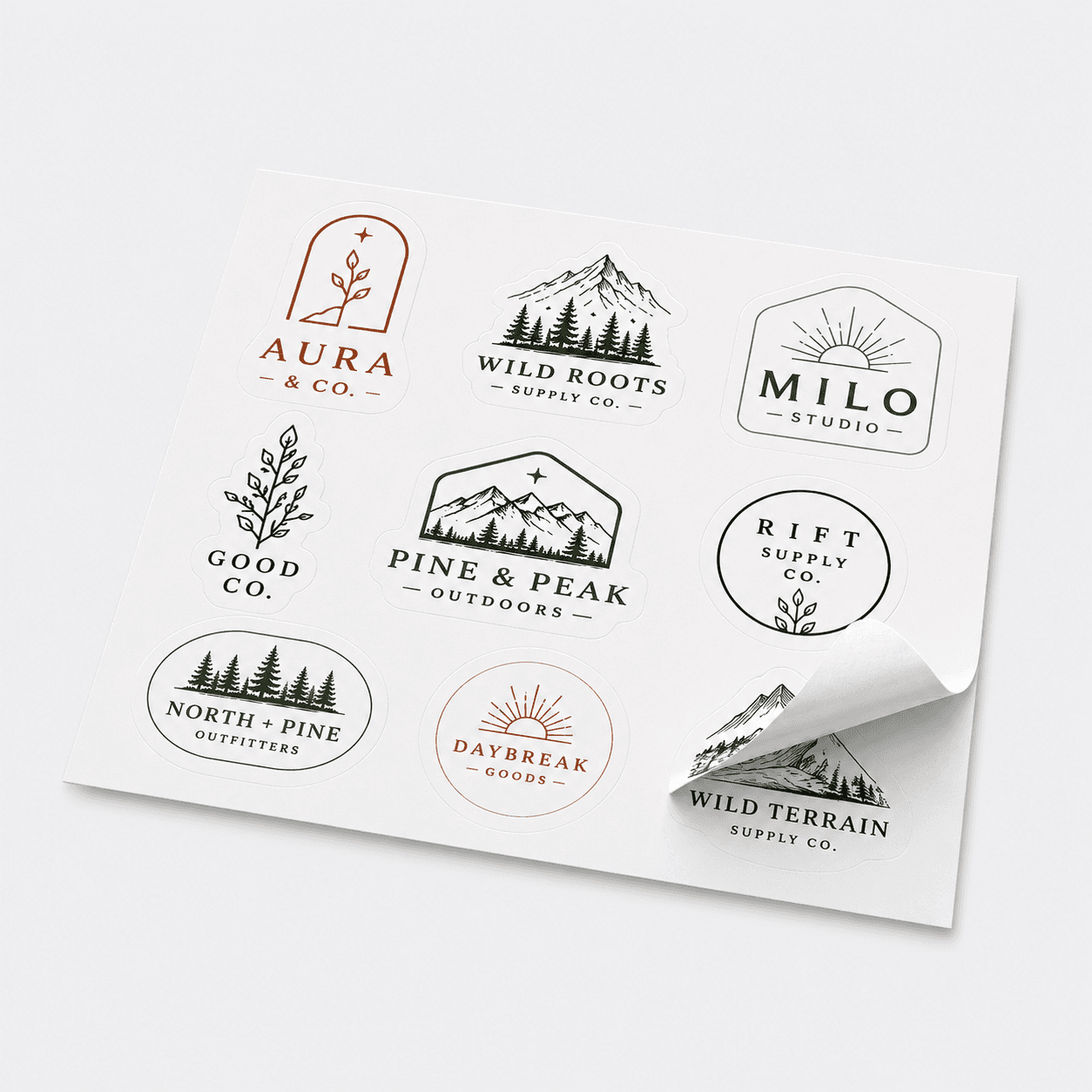
Two of the most popular sticker styles look almost identical online but feel completely different in your hands. Die-cut and kiss-cut stickers use the same materials and the same printing process. What changes is how the cutting machine handles the edges. That small difference affects packaging, peel experience, and how the sticker ends up on the customer's water bottle.
What is a die-cut sticker?
A die-cut sticker is cut all the way through both the vinyl face and the paper backing, following the exact shape of your design. When you hand someone a die-cut sticker, they hold a piece shaped like your logo, your mascot, or whatever artwork you sent us. There is no extra border, no rectangle, just the shape.
Die-cut stickers feel premium because the silhouette is the product. They are the standard choice for:
- Brand logo stickers handed out at events
- Laptop and tumbler stickers sold as merch
- Promotional drops where the shape itself is part of the marketing
- Anything that gets stuck to a curved or visible surface
What is a kiss-cut sticker?
A kiss-cut sticker is printed the same way, but the cutting machine only slices through the top vinyl layer. The paper backing underneath stays as a rectangle (or any larger shape you want).
The result: the sticker shape is cut, but it stays attached to a flat, easy-to-handle backing card. Customers peel the sticker off the backing when they are ready to use it.
Kiss-cut works best when:
- You are mailing stickers and want a flat, ship-friendly product
- You want room for a brand name, instructions, or a thank you message on the backing
- You are bundling several stickers on one sheet (think sticker sheets)
- Small or intricate shapes would be hard to peel from a tight die-cut
The peel test: why this matters
Here is the practical difference: try peeling a tiny die-cut sticker shaped like a star. The points are fiddly. You will fight with the corner before it lifts.
Now picture the same star as a kiss-cut on a 3 inch by 3 inch backing. You peel the whole backing off the star comes with it. No fighting, no torn points.
For small, detailed, or multi-piece designs, kiss-cut is almost always the better customer experience. For a single bold shape that is 2 inches or larger, die-cut wins on shelf appeal.
How shipping and packaging change
Shape affects how stickers stack and ship.
- Die-cut: ship best in rigid envelopes or with cardboard backing. The custom shape can fold if you stuff them loose.
- Kiss-cut: ship flat by default because the rectangular backing protects every edge. Easier to mail in a standard letter envelope.
If you sell stickers as a product (not a giveaway), kiss-cut almost always lowers your fulfillment costs because you can drop them in a flat mailer without extra protection.
When to use each one
A quick cheat sheet:
- Promotional handouts at a booth: die-cut. The shape is the whole point.
- E-commerce sticker pack with 4 to 8 designs: kiss-cut sheet.
- Single hero logo sticker, 3 inches or larger: die-cut.
- Tiny accent stickers, half-inch icons: kiss-cut, always.
- Customer applies sticker in a clean studio setting: either works.
- Customer peels and applies on the go: kiss-cut, every time.
What about price?
At the same size, die-cut and kiss-cut stickers cost about the same. The cut style does not change the material, the ink, or the size of the print. It only changes what the cutting machine does at the end. Pick the format that fits how your customer will use the sticker, not how much it costs.
Ready to order?
Most brands end up using both: die-cut for the hero logo merch piece, kiss-cut for sticker packs and small accents. Order a small batch in each style and feel the difference before you commit to a large run.
Browse die-cut stickers or shop kiss-cut stickers to get started.